Get D1 Dvla Form in PDF
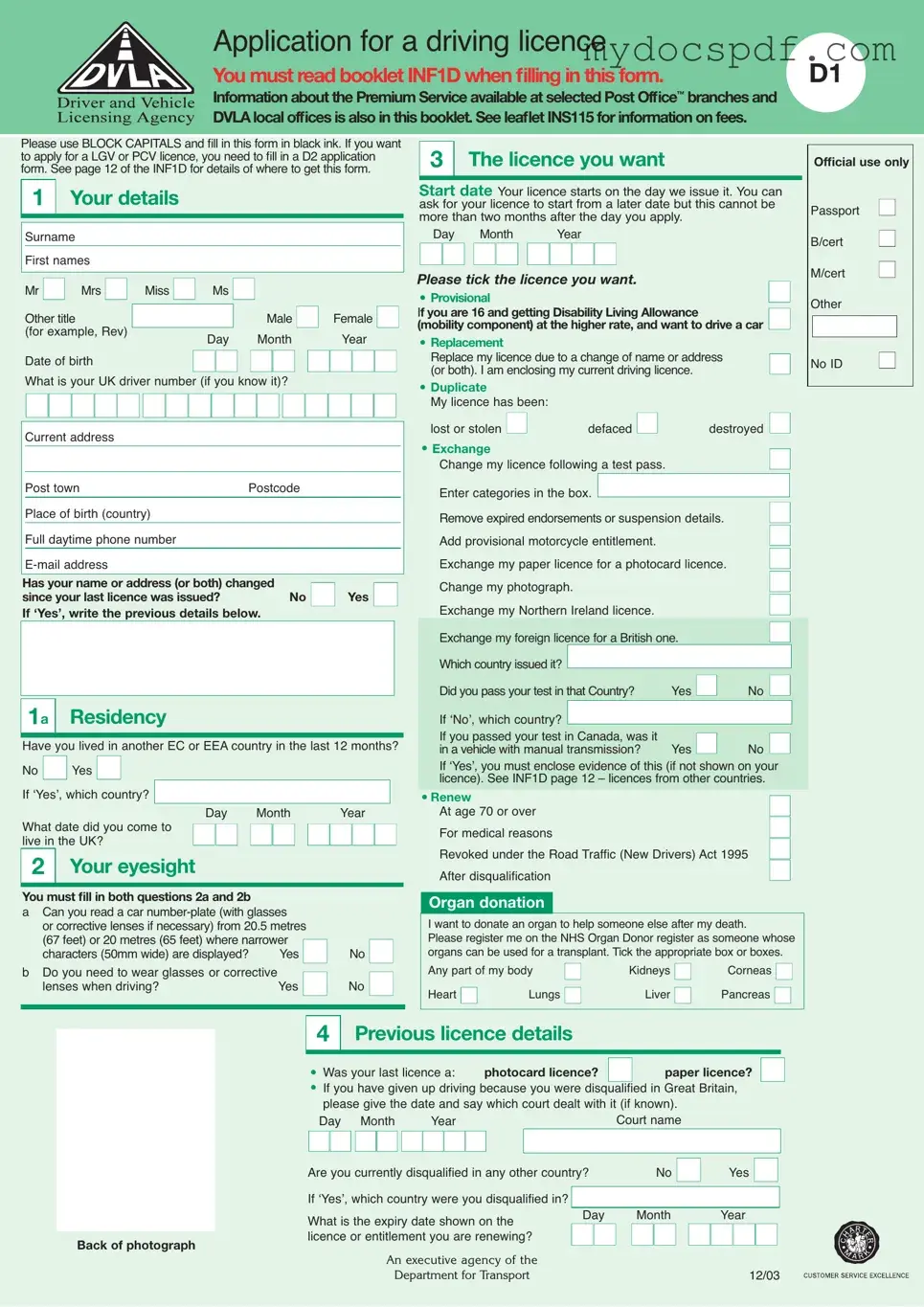
The D1 DVLA form is a crucial document for individuals seeking to apply for or update their driving licence in the United Kingdom. It serves a variety of purposes, including applying for a new licence, renewing an existing one, or replacing a lost or stolen licence. The form requires applicants to provide personal details, such as their name, address, and date of birth, as well as information about their residency and driving history. Additionally, the form includes sections that assess an applicant's eyesight and health, ensuring that they meet the necessary criteria to drive safely. Applicants must also confirm their identity by providing appropriate documentation and may need to have someone sign the back of their photograph. Fees associated with the application process are outlined in accompanying leaflets, and specific instructions must be followed to ensure the form is completed correctly. For those applying for specific types of licences, such as LGV or PCV, a different form, the D2, is required. Overall, the D1 DVLA form plays an essential role in maintaining road safety and ensuring that drivers are fit to operate a vehicle.
Dos and Don'ts
When filling out the D1 DVLA form, it's essential to approach the task with care. Here are some important dos and don'ts to keep in mind:
- Do read the accompanying booklet INF1D thoroughly before starting.
- Do use BLOCK CAPITALS and black ink for clarity.
- Do ensure all required fields are filled out completely.
- Do double-check your identity documents to ensure they meet the requirements.
- Don't leave any sections blank; incomplete forms may be returned.
- Don't forget to sign the application in the designated area.
- Don't use photocopies of identity documents; originals are necessary.
- Don't submit your application without the correct fee enclosed.
Document Attributes
| Fact Name | Details |
|---|---|
| Purpose of the D1 Form | The D1 form is used for applying for a UK driving licence. This includes both new applications and renewals. |
| Application Instructions | Applicants must read the booklet INF1D while filling out the D1 form. It provides essential information and guidance. |
| Eligibility Criteria | To apply for certain types of licences, such as LGV or PCV, individuals must complete a different form, the D2. |
| Vision Requirements | Applicants must demonstrate the ability to read a car number plate from a specified distance, with or without corrective lenses. |
| Health Disclosure | Part A of the form requires disclosure of any medical conditions that could affect driving ability. Failure to do so may result in application rejection. |
| Signature Requirement | Applicants must sign the form, acknowledging the legal implications of providing false information, which can lead to prosecution. |
Key takeaways
Carefully read the booklet INF1D before completing the D1 DVLA form. This booklet provides essential information and instructions.
Use BLOCK CAPITALS and black ink when filling out the form to ensure clarity and legibility.
Provide accurate personal details, including your UK driver number, current address, and contact information.
Be aware of your eyesight requirements. You must confirm whether you can read a car number plate from the specified distance.
Choose the correct type of licence you are applying for, such as provisional, replacement, or renewal.
Submit all necessary identity documents and ensure that someone reliable signs the back of your photograph if required.
Other PDF Templates
Birth Certificates - The U.S. Standard Certificate helps maintain consistent data collection across states.
What Does the S in S Corp Stand for - Timely filing of Form 2553 can impact a business's financial advantages.
In addition to understanding the importance of the New York Operating Agreement, businesses may also find valuable resources, like the one provided by NY Templates, which can help streamline the creation of this essential document for their LLCs.
Rx Pad - Facilitate timely access to prescribed treatments.
Example - D1 Dvla Form
Application for a driving licence
You must read booklet INF1D when filling in this form.
Information about the Premium Service available at selected Post Office™ branches and DVLA local offices is also in this booklet. See leaflet INS115 for information on fees.
D1
Please use BLOCK CAPITALSand fill in this form in black ink. If you want to apply for a LGV or PCV licence, you need to fill in a D2 application form. See page 12 of the INF1D for details of where to get this form.
1Your details
Surname
First names
Mr ■ Mrs ■ Miss ■ Ms ■
Other title |
|
Male ■ Female ■ |
(for example, Rev) |
Day Month Year |
|
|
||
Date of birth |
■■ ■■ ■■■■ |
|
What is your UK driver number (if you know it)?
■■■■■■■■■■■■■■■■
Current address
Post town |
Postcode |
Place of birth (country) |
|
Full daytime phone number
Has your name or address (or both) changed |
No ■ Yes ■ |
|
since your last licence was issued? |
||
If ‘Yes’, write the previous details below. |
|
|
|
|
|
1a Residency
Have you lived in another EC or EEAcountry in the last 12 months? No ■ Yes ■
If ‘Yes’, which country?
Day |
Month |
Year |
What date did you come to
live in the UK? ■■ ■■ ■■■■
2Your eyesight
You must fill in both questions 2a and 2b
a Can you read a car
or corrective lenses if necessary) from 20.5 metres |
|
(67 feet) or 20 metres (65 feet) where narrower |
|
characters (50mm wide) are displayed? |
Yes ■ No ■ |
b Do you need to wear glasses or correctiveYes ■ No ■
3The licence you want
Start date Your licence starts on the day we issue it. You can ask for your licence to start from a later date but this cannot be more than two months after the day you apply.
Day Month |
Year |
|
■■ ■■ ■■■■ |
|
|
Please tick the licence you want. |
■ |
|
• Provisional |
|
|
If you are 16 and getting Disability Living Allowance■
(mobility component) at the higher rate, and want to drive a car
• Replacement |
|
|
|
|
|
|
Replace my licence due to a change of name or address |
■ |
|
||||
(or both). I am enclosing my current driving licence. |
|
|||||
• Duplicate |
|
|
|
|
|
|
My licence has been: |
|
|
|
|
|
|
lost or stolen ■ |
defaced ■ |
destroyed ■ |
|
|||
• Exchange |
|
|
|
■ |
|
|
Change my licence following a test pass. |
|
|
||||
Enter categories in the box. |
|
|
|
|
||
|
|
■ |
|
|||
Remove expired endorsements or suspension details. |
|
|||||
Add provisional motorcycle entitlement. |
|
■ |
|
|||
Exchange my paper licence for a photocard licence. |
■ |
|
||||
Change my photograph. |
|
|
|
■ |
|
|
Exchange my Northern Ireland licence. |
|
■ |
|
|||
Exchange my foreign licence for a British one. |
■ |
|
||||
Whichcountryissuedit? |
|
|
|
|
|
|
DidyoupassyourtestinthatCountry? |
Yes ■ |
No ■ |
|
|||
If ‘No’, which country? |
|
|
|
|
|
|
If you passed your test in Canada, was it |
Yes ■ |
No ■ |
|
|||
inavehiclewith manual transmission? |
|
|||||
If ‘Yes’, you must enclose evidence of this (if not shown on your licence). See INF1D page 12 – licences from other countries.
•Renew |
■ |
At age 70 or over |
|
For medical reasons |
■ |
Revoked under the Road Traffic (New Drivers) Act 1995 |
■ |
After disqualification |
■ |
Organ donation
I want to donate an organ to help someone else after my death.
Please register me on the NHS Organ Donor register as someone whose organs can be used for a transplant. Tick the appropriate box or boxes.
Any part of my body ■ |
Kidneys ■ |
Corneas ■ |
Heart ■ Lungs ■ |
Liver ■ |
Pancreas ■ |
Official use only
Passport ■
B/cert ■
M/cert ■
Other
No ID ■
4Previous licence details
• Was your last licence a: |
photocard licence? |
■ |
paper licence? ■ |
||||||
• If you have given up driving because you were disqualified in Great Britain, |
|||||||||
please give the date and say which court dealt with it (if known). |
|
|
|||||||
Day Month |
Year |
|
|
|
Court name |
|
|
||
■■ ■■ ■■■■ |
|
|
|
|
|
|
|||
Are you currently disqualified in any other country? |
|
No ■ Yes ■ |
|||||||
If ‘Yes’, which country were you disqualified in? |
|
|
|
|
|
||||
|
|
|
|
|
|||||
What is the expiry date shown on the |
Day |
|
Month |
Year |
|||||
■■ ■■ ■■■■ |
|||||||||
licence or entitlement you are renewing? |
|||||||||
An executive agency of the |
|
|
|
|
|
||||
Department for Transport |
|
|
|
12/03 |
|
||||

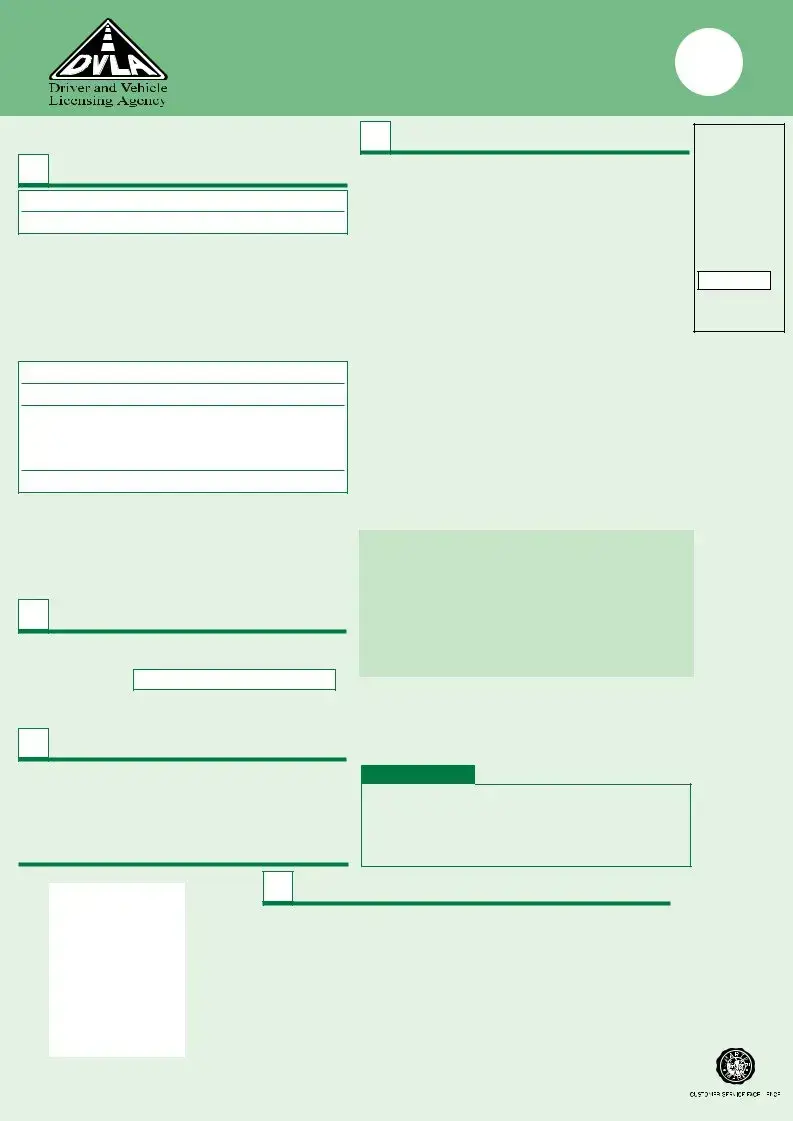
5Your health
You must fill in either part A or part B or we will send your application back to you.
If you have already told us about a medical condition that could affect your fitness to drive – and you have no new medical condition
– miss out part Aand go on to part B of this section.
Part A
Have you ever had, or do you currently suffer from |
|
any of the following conditions? |
No ■ Yes ■ |
If you have answered ‘Yes’, please tick all the appropriate boxes.
1 |
Epilepsy |
■ |
2 |
Fits or blackouts |
■ |
3 |
Repeated attacks of sudden disabling giddiness |
■ |
4 |
Diabetes controlled by insulin |
■ |
5 |
Diabetes controlled by tablets |
■ |
6 |
An implanted cardiac pacemaker |
■ |
7 |
An implanted cardiac defibrillator (ICD) |
■ |
8 |
Angina (heart pain) which is easily brought on by driving |
■ |
9 |
Persistent alcohol misuse or dependency |
■ |
10 |
Persistent drug misuse or dependency |
■ |
11 |
Parkinson’s disease |
■ |
12 |
Narcolepsy or sleep apnoea syndrome |
■ |
13 |
Stroke, with any symptoms lasting longer than |
■ |
|
one month, recurrent |
|
14 |
Any type of brain surgery, severe head injury |
■ |
|
involving inpatient treatment, or brain tumour |
|
15 |
Any other chronic neurological condition |
■ |
16 |
Aserious problem with memory or periods of confusion |
■ |
17 |
Severe learning disability |
■ |
18 |
Serious psychiatric illness or mental ill health |
■ |
19 |
Total loss of sight in one eye |
■ |
20 |
Any condition affecting both eyes, or the remaining eye |
|
|
if you only have one eye |
■ |
|
(not including colour blindness or short or long sight) |
|
21 |
Any condition affecting your visual field |
■ |
22 |
Any persisting limb problem which needs |
|
|
driving to be restricted to certain types |
■ |
|
of vehicle or those with adapted controls |
If you have answered YES to one of the above questions you may be required to complete a medical questionnaire. Questionnaires are available on the DVLAwebsite http://www.dvla.gov.uk to be sent in with your application.
Part B
Only fill in this part if you have told us about a medical condition before.
You must read pages 6 to 10 of the INF1D before filling in section 6 and 7. Do not fill in sections 6 and 7 or supply a new photograph if you have a photocard licence, unless you are registering a change of name, photograph or signature. UK birth/adoption certificates are not acceptable as sole proof of identity and we may ask for further evidence. We are unable to verify details on
6Confirming your identity
Tick the documents you are providing to prove your identity – see pages 6, 7 and 8 of INF1D for more details. Photocopies are not acceptable.
Passport ■Your UK birth or adoption certificate ■
EC or EEAidentity card ■ TravelDocument■
Evidence of SRP(State Retirement Pension) ■
Also, please write the identity number of the document you are providing.
Tick the documents you are also providing to show a clear link to your current name if different from that shown on your passport, birth certificate or adoption certificate.
Marriage certificate ■ Divorce certificate ■
Your deed poll or statutory declaration ■
Also,pleasewritetheidentitynumbersofthedocumentsyouareproviding.
7Signing your photograph
Warning: This person must have known you personally for at least two years, and must not be a relative or a member of the Post Office™ staff processing the application, if you choose to use the Premium Checking Service – see page 13 of INF1D for more details.
TO BE FILLED IN BY THE PERSON SIGNING YOUR PHOTOGRAPH.
State how many years you have known the applicant: This MUST be at least 2 years.
I have signed the back of the photograph which is a true likeness of the applicant.
Signature |
|
Date |
|
Full name
Business or home address
Postcode
Full daytime phone number
ProfessionQualifications
Warning: We will make random checks on those who sign photographs for driving licence applications.
What is the condition? 

Has it got worse since you told us about it? |
No ■ Yes ■ |
Have you had any special controls fitted to...............your |
No ■ Yes ■ |
vehicle since your last licence was issued? |
Post Office™ date stamp
Document checklist
Make sure you have enclosed the following where they apply.
Tick the appropriate boxes.
The correct fee |
■ |
(See leaflet INS115 for fees |
|
and details on how to pay.) |
|
Amount |
|
8Your signature
I understand that it is a criminal offence if I make, or anyone else makes, a false declaration to get a licence and to do so can lead to prosecution and a fine of up to £2500. I also understand it is an offence to fail to provide information which can lead to prosecution with a fine of up to £1000.
Important
See page 11 of INF1D. |
Date |
➦ |
|
➦ |
|
Peel here |
|
|
|
|
PLACE PHOTOGRAPH |
||
Cheque or postal order number
Identity documents (if this applies)
Yourlastlicence(andcounterpart ifthisapplies)
Your test pass certificate (if thisapplies)
You may wish to use a secure delivery service to send your identity documents to us. Enclose a
■
■
■
We will not accept this application unless you sign below in black ink and your signature is completely within the white box.
• Keep your signature within the white box •
• Keep your signature within the white box •
|
FACE UP |
|
See page 9 and 10 |
|
of INF1D |
➦ |
Peel here |
➦ |
|
|
We no longer issue paper licences. Your new licence will be a plastic photocard, a paper counterpart will accompany it. You must produce
both if the police or a court ask for them. You should also present both when taking a driving test. Other organisations such as
Detailed Instructions for Writing D1 Dvla
Completing the D1 DVLA form is an important step in applying for a driving licence. This process requires careful attention to detail to ensure all necessary information is provided accurately. Below are the steps to guide you through filling out the form.
- Read the booklet INF1D: Familiarize yourself with the instructions and requirements outlined in the booklet before starting.
- Fill in your details: Use BLOCK CAPITALS and black ink. Provide your surname, first names, title, gender, date of birth, UK driver number (if known), current address, post town, postcode, place of birth, daytime phone number, and email address.
- Address changes: Indicate if your name or address has changed since your last licence was issued. If yes, provide the previous details.
- Residency information: Answer whether you have lived in another EC or EEA country in the last 12 months and provide the date you came to live in the UK if applicable.
- Eyesight questions: Answer both questions regarding your ability to read a car number plate and whether you need corrective lenses.
- Select the type of licence: Choose the appropriate option for the licence you are applying for, such as provisional, replacement, duplicate, exchange, or renewal.
- Previous licence details: Indicate whether your last licence was a photocard or paper licence and provide details if you have been disqualified in the past.
- Health declaration: Complete either Part A or Part B regarding any medical conditions that could affect your ability to drive.
- Identity verification: Tick the documents you are providing to prove your identity and write the identity number of each document.
- Photograph signing: If required, ensure someone reliable has signed the back of your photograph, confirming it is a true likeness of you.
- Document checklist: Confirm that you have enclosed all necessary documents and the correct fee.
- Signature: Sign the form in black ink, ensuring your signature is within the designated white box.
After completing the form, review all entries to ensure accuracy. Once you are satisfied, submit the form along with any required documents and payment. Your application will be processed, and you will receive your new driving licence in due course.
Documents used along the form
The D1 DVLA form is essential for applying for a driving licence in the UK. Along with this form, several other documents may be required to support the application process. Below is a list of commonly used forms and documents that complement the D1 DVLA form.
- D2 Application Form: This form is necessary for individuals applying for a Large Goods Vehicle (LGV) or Passenger Carrying Vehicle (PCV) licence. It provides specific information required for these types of licences.
- Residential Lease Agreement: To ensure clarity in rental agreements, refer to our detailed residential lease agreement guidelines for a smooth leasing experience.
- INF1D Booklet: This informational booklet accompanies the D1 form. It contains detailed instructions on how to fill out the application and outlines the fees associated with obtaining a driving licence.
- Medical Questionnaire: If the applicant has a medical condition that may affect their ability to drive, a medical questionnaire may be required. This document helps assess fitness to drive based on health considerations.
- Identity Documents: Applicants must provide proof of identity. Acceptable documents include a passport, birth certificate, or an EC/EEA identity card. These documents verify the applicant's identity and support their application.
Having these documents ready can streamline the application process and help ensure that all necessary information is submitted accurately. It is advisable to review the requirements thoroughly before proceeding with the application.